

Private Label Men's Business Casual Socks: The Complete Guide for Brands and Retailers
2026-10-12
Finding the right private label partner for men's business casual socks can feel like searching for a needle in a haystack—until you discover a manufacturer that truly understands both comfort and brand identity. At KINDWAY, we’ve spent years perfecting the balance between professional polish and all-day wearability, and this guide unpacks everything brands and retailers need to know. From yarn selection to packaging strategies, you’ll learn how to turn a basic wardrobe staple into a signature product that keeps customers coming back.
Why Business Casual Socks Are the Quiet Workhorse of Men's Wardrobes
Most men spend a surprising amount of mental energy on shoes, trousers, and shirts, yet give almost no thought to the thin layer of fabric between ankle and sole. Business casual socks don't scream for attention, but they quietly decide whether an outfit feels polished or half-finished. A well-chosen pair in merino wool or combed cotton bridges the gap between formal and relaxed, keeping feet dry during long meetings and preventing that awkward flash of bare skin when you cross your legs.
The real workhorse quality comes from versatility. Unlike bold statement socks that only work with one specific look, muted tones like charcoal, navy, or deep burgundy slide effortlessly under chinos, wool trousers, or even dark denim. They absorb sweat, cushion every step, and resist sagging by midday — all while staying invisible enough to let the rest of your outfit do the talking. Over time, you'll find yourself reaching for the same few pairs again and again, not because they're exciting, but because they never let you down.
Durability matters more than most men realize. Cheap dress socks thin out at the heel after a dozen wears, forcing you to replace them constantly. Quality business casual socks, on the other hand, use reinforced toes and heels, plus a bit of stretch for shape retention. That upfront cost pays off in months of reliable service. When you finally stop thinking about your socks and start trusting them, that's when you understand why they're the quiet workhorse of your wardrobe.
Fabric Blends That Survive the Washing Machine and Still Look Sharp
A 65/35 cotton-polyester shirt is the quiet workhorse of a low-maintenance wardrobe. Cotton gives the fabric enough breath to keep you comfortable, while the polyester threads lock the weave in place so collars and cuffs don't curl or crease after a spin cycle. Pull it from the washer, give it a shake, and it hangs flat without ironing—something pure cotton rarely manages.
Wool-synthetic blends have moved past scratchy '70s suits. A merino-nylon knit, for instance, can handle a cold gentle cycle if you skip the fabric softener and dry it flat. The nylon core keeps the wool from felting or stretching out of shape, so the garment still looks tailored on day thirty instead of sagging at the elbows.
For pants and jackets that see real movement, look for a cotton-elastane or wool-elastane mix—usually 2-5% elastane. That small amount of stretch lets the fabric recover its shape after sitting and bending, but it doesn't interfere with washing. The result is a pair of chinos that comes out of the machine with a crisp front crease still intact.
The Toe Seam Test: How Small Construction Details Determine Repeat Purchases
You can tell more about a sock from the inside of its toe than from any logo stitched on the cuff. The toe seam is the first point of contact with the ground with every step, and if it's bulky, misaligned, or finished with a rough thread, the discomfort builds within the first hour of wear. It doesn't matter how soft the yarn is or how clever the moisture-wicking claims are; a poorly executed toe closure turns a promising pair into a one-time purchase.
Repeat buyers rarely articulate this consciously, but their feet remember. A hand-linked toe seam lies flat across the top of the toes, eliminating the ridge that rubs against the nail bed or the inside of a shoe. That kind of detail costs more in production and takes longer to finish, which is why most mass-market brands cut corners here first. The customer may not know the difference between linking and overlocking, but they know which sock they reach for on a long day.
That quiet preference is what drives loyalty. When the toe seam disappears, the product stops competing on price and starts earning a place in the drawer. It's a small construction decision with an outsized influence on whether someone clicks "buy again" or never returns.
Pattern Play: Designing Socks That Add Personality Without Breaking Dress Codes
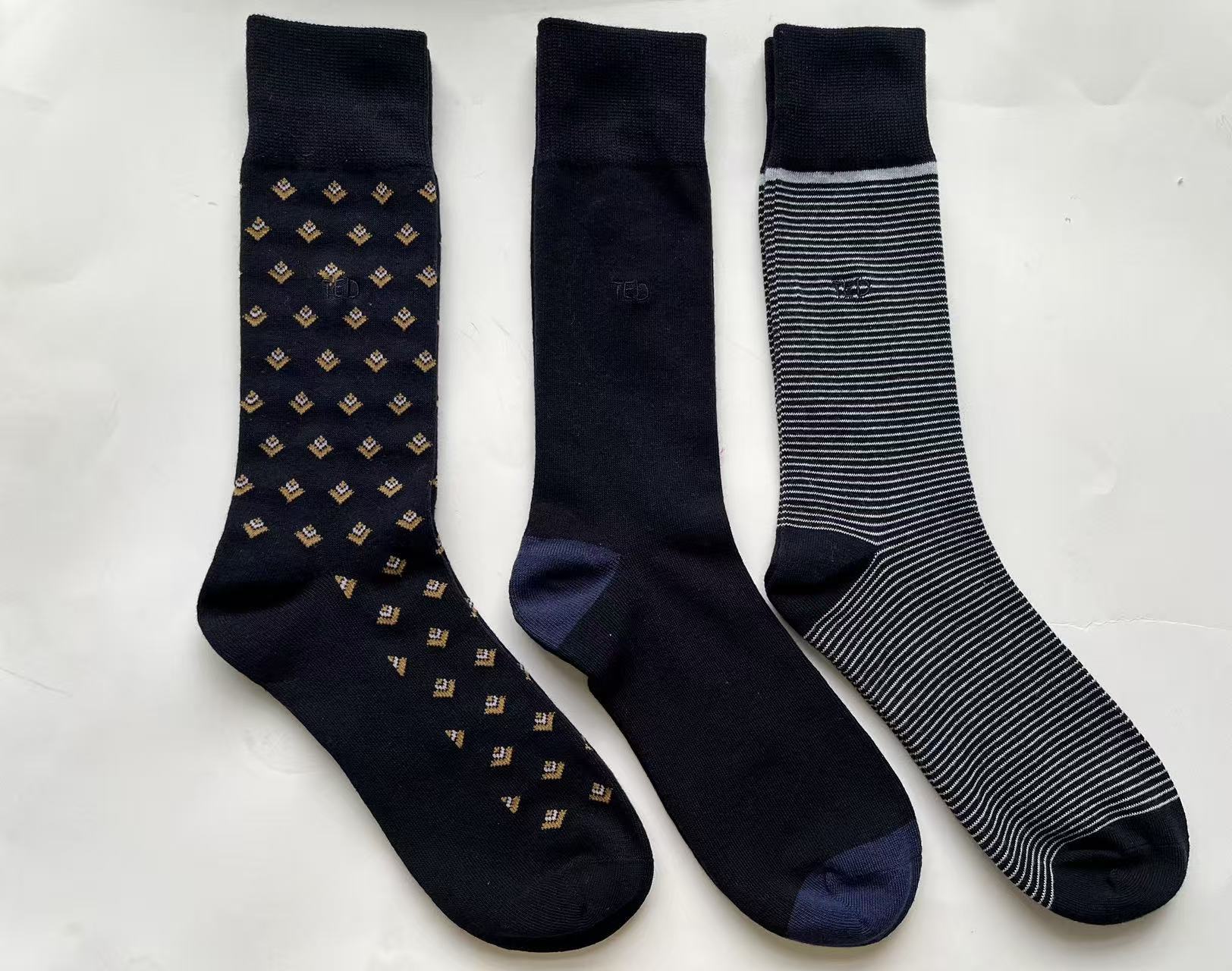
The trick to wearing patterned socks in a formal or business casual setting is to treat the pattern as a low-volume accent rather than a statement piece. A fine houndstooth, a micro-dot, or a narrow stripe in colors that echo the trousers or shoes reads as a considered detail from a few feet away, yet maintains a sense of restraint up close. The goal is to let texture and scale do the work—think of the pattern as something you notice second, not first.
Another approach is to anchor the sock to a secondary color already present in your outfit. If you're wearing a navy suit with a burgundy tie, a sock that uses burgundy as its dominant pattern color against a dark ground will feel intentional without clamoring for attention. Avoid large motifs, bright contrasts, or novelty prints unless your workplace has explicitly relaxed its dress code. Instead, choose patterns that repeat densely and stay within one tonal family, which keeps the eye moving without pulling focus from the rest of the ensemble.
Packaging as a Brand Statement: From Shelf Appeal to Mailer Unboxing
A package rarely gets a second chance to argue its case. On a crowded shelf, a muted navy box with debossed lettering can stop a hand mid-reach, not because it shouts, but because it refuses to. The weight of the paper stock, the resistance of the flap, even the font kerning on a hangtag all send signals about whether the brand bothered. Shelf appeal lives in those small, almost invisible decisions: a matte finish instead of gloss, a spot of foil on the edge, a label aligned with obsessive care.
Then the moment shifts. The same product bought online arrives in a corrugated mailer, and suddenly the package has to do a different job. A torn exterior or a single sheet of crumpled kraft paper can undo the confidence built on the shelf. Smart brands design the unboxing as a continuation: a tissue wrap printed in-house, a sticker sealing the inner fold, a note card that reads like a private message rather than a promotional insert. The reveal feels less like opening a shipment and more like unwrapping a decision already made.
That continuity is what turns packaging into a statement. It is not about adding more layers or spending more on ribbon. It is about matching the voice of the box to the promise of the product. When a jar of hand cream arrives in a box that smells faintly of the same botanical blend, or when a pair of socks comes folded inside a sleeve that mirrors the pattern on the heel, the packaging stops being a container and starts carrying memory. Buyers may forget a discount code, but they remember the sound of a well-made lid coming off.
Moving Beyond the Multi-Pack: Subscription Models and Seasonal Refreshes
The era of buying socks in bulky multi-packs is fading. More brands now offer subscription models where customers receive a fresh pair or two every month, tailored to their style preferences. This shift isn't just about convenience—it's about treating socks as a consumable that wears out, rather than a one-time bulk purchase. With gentle nudges like wear-and-tear reminders or seasonal pattern swaps, subscribers stay engaged without feeling locked in.
Seasonal refreshes play a big role here. Instead of pushing the same striped crew socks year-round, smart brands rotate in lightweight bamboo blends for spring, moisture-wicking merino for summer hikes, and cushioned thermal knits when temperatures drop. This keeps the assortment feeling alive and gives customers a reason to look forward to the next box. It also reduces overstock waste, since production aligns more closely with real-time demand.
What sets successful subscription models apart is the ability to pause, skip, or swap with zero friction. Nobody wants another forgotten charge on their credit card. By offering flexible delivery frequencies—every month, every other month, or just before a big trip—brands build trust and reduce churn. Combined with early access to limited-edition colorways for loyal subscribers, the model moves beyond simple replenishment into a small monthly ritual people actually enjoy.
FAQ
Business casual socks fill the middle ground. They use a mid-weight knit that is less shiny than formal dress socks but more refined than gym socks. You will see subtle patterns like micro-dots, heathered textures, or tonal ribs, and they are cut to pair well with chinos, denim, and loafers rather than just suits.
Start with combed or mercerized cotton blended with nylon and a small percentage of spandex for stretch and recovery. Merino wool works well for cooler markets because it resists odor and regulates temperature. Avoid 100% cotton unless you want complaints about sagging and holes after a few washes.
Ask for physical samples before any deposit. Check their minimum order quantities, lead times, dye lot consistency, and whether they carry OEKO-TEX or similar certifications. If you cannot visit the factory, request a live video walkthrough of the knitting, linking, and boarding areas to spot outdated equipment or poor working conditions.
Focus on small-scale geometric patterns, marled or heathered yarns, contrast toe and heel colors, and ribbed cuffs that stay up without digging into the calf. A subtle logo on the inside cuff or bottom of the foot adds brand presence without looking flashy.
Calculate landed cost including freight and duties, then add packaging and fulfillment. For wholesale, target a 2.5 to 3 times markup on total cost. Direct-to-consumer can support 55 to 70 percent gross margins. Position above basic multipacks but below luxury Italian dress socks to avoid a race to the bottom.
Use paper bands, recyclable boxes, or minimal polybags with a clear callout for size, material blend, and care instructions. For multipacks, avoid excessive plastic and include a short benefit line like pre-shrunk cotton or reinforced toe on the outer label so buyers understand the value quickly.
Shrinkage after the first wash, rough toe seams, fading in dark colors, and elastic losing stretch are the most frequent complaints. Specify pre-shrunk yarns, hand-linked or smooth toe closures, and test for colorfastness and stretch recovery before approving bulk production.
Stick to five to eight core styles. A solid mid-gray and navy, two micro-patterns, one ribbed or textured option, one merino blend for colder months, and a quarter-length or no-show if you sell into warmer climates. This keeps inventory manageable while still giving buyers enough choice.
Conclusion
The real test of a private label business casual sock isn't the first wear—it's the twentieth. That's why fabric selection matters more than most buyers expect. A blend with enough synthetic fiber to hold shape through repeated machine washes, yet enough natural yarn to stay breathable at a desk, quietly separates dependable inventory from one-season disappointment. Equally important is the toe seam: a bulky or misaligned seam guarantees complaints, while a smooth, hand-linked finish becomes the kind of detail customers notice only when it's absent. For pattern, the sweet spot lies in subtle texture or small-scale motifs—think micro-geometrics or tonal stripes—that read as intentional in a business setting without shouting. These choices keep the sock from being a throwaway commodity and instead make it the quiet backbone of a working wardrobe.
Packaging and selling strategy often get treated as afterthoughts, yet they shape how the product is perceived before it's ever worn. A well-designed band or box can turn a basic sock into a giftable or impulse purchase on a crowded shelf, while a mailer that arrives with a considered unboxing moment adds perceived value without inflating cost. Retailers should also look past the standard three-pack. Introducing a subscription model that delivers fresh pairs on a schedule, or rotating seasonal color updates that align with wardrobe shifts, creates ongoing relevance and repeat orders. Together, these moves—from stitching to shelf to replenishment—let a private label line hold its own against bigger names by offering something they often forget: a complete, considered experience rather than just another pair of socks.
Contact Us
Contact Person: Alfred Lee
Email: [email protected]
Tel/WhatsApp: +86 13806701496
Website: https://www.hainingsocks.com/